
Challenge and opportunities at the British Pig & Poultry Fair
13th May 2026
Pig & Poultry Fair. NEC, Birmingham
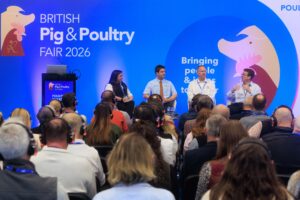
Demand for eggs and poultry meat is strong and growing – so there are plenty of opportunities in each sector. But pig producers are facing a downturn – and there are considerable hurdles for all to overcome, according to speakers at the British Pig and Poultry Fair on May 13.
Consumer demand for high-quality animal protein is rising – particularly where it is affordable and convenient – which plays to each sector’s advantage. But tightening animal welfare legislation in the UK, alongside restrictive planning policies, is throttling growth and opening the door to imports that wouldn’t meet domestic standards.
Egg consumption has risen by 20% since 2019, but still remains behind many other countries on a per-capita basis, said Barney Kay, agricultural director at Noble Foods. Organic and golden yolk brands are doing well, as are processed products like boiled eggs, frittatas, omelettes and liquid eggs.
However, proposals to phase out colony systems and restrictive planning policies mean producers will not be able to keep up with demand. “We’re seeing a huge influx of Ukrainian eggs,” said Nick Allen, chief executive at the British Egg Industry Council. “If you’re going to ban systems of production in this country, you have to ban imports produced to those same standards.”
One of the problems at government level is a lack of agricultural knowledge, and an attempt to eliminate risk rather than control it, said Nick. “The regulatory environment is in flux all the time – there’s no stability.” Employment, tax, health and environmental departments don’t talk to each other, so one policy ends up undermining another. “We need a joined-up approach.”
Avian influenza is another significant threat – and Noble Foods has been working with Livetec Systems to help its farmers adopt more effective protection, said Barney. “It’s about ensuring we’re focusing on the right areas.” It’s also important that staff buy in to best practice biosecurity, warned Nick. “Everyone knows what to do, but it’s a people point. A cultural shift needs to happen.”
There is hope that the vaccine trial in turkeys will prove successful, enabling a roll-out across the poultry sector, said Mark Gorton, managing director at Traditional Norfolk Poultry. “But it’s worldwide problem not a UK problem, and it won’t be an overnight success.”
It’s also important that trade barriers are removed, to enable more widespread use of the vaccine, warned David Neilson, agriculture director at Avara Foods. “I wouldn’t be prepared to grow my Christmas turkey business without the vaccine – it’s not worth the risk.”
Many producers are keen to invest – but they need the confidence and cash flow do so, said Sam Drummond, director of poultry at Worcestershire-based EC Drummond. “It’s very hard to expand – planning permission is our biggest challenge.”
Another area of both challenge and opportunity is the food service and public procurement sector, said Mark. “We’ve got products like wings and drumsticks that we struggle to sell – the procedures and protocols are so restrictive.” But rather than serving Chinese chicken breasts in schools, they should instead be signposted to high-quality, local value cuts.
In the pig sector, last year’s buoyant mood has turned to one of concern amid falling prices, oversupply and factory failures, with some producers served notice on their contracts. However, in the longer term, pig meat remains well-placed to meet consumer needs.
Fabio Brancher, operations director at Pilgrim’s Europe, outlined how the processor is working to reduce the slaughter backlog, opening nine additional factories in March to ease pressure on the congested supply chain. The business slaughtered a record 48,000 pigs last week, compared with its usual target of 43,000 a week.
Concerns around African Swine Fever remain high within the sector, with processors and industry bodies continuing to strengthen contingency planning. It’s vital that the industry work together – including increased vigilance against illegal imports at UK borders, said Fabio.
“We are still waiting for the government to provide a plan, but it still hasn’t,” said Lizzie Wilson, chief executive at the National Pig Association. “In the meantime, we’ve been carrying out simulation exercises with the whole supply chain and working through contingency plans if it happened tomorrow.”
Tessa Seymour, commercial director at ABN, said: “The Pig and Poultry Fair is the perfect opportunity to meet and discuss these issues, and there was a real buzz. Bringing the supply chain together is so important, to help foster understanding and encourage collaborative approaches to overcome hurdles and make the most of the opportunities available.
- The British Pig and Poultry Fair takes place again tomorrow, Thursday 14 May at the NEC, Birmingham. For more information visit pigandpoultry.org.uk.